As Ireland’s economy becomes ever more digitised, the question of how the country develops, attracts and sustains technology talent has never been more pressing. While university pathways remain vital, another route has quietly been reshaping the tech workforce: apprenticeships.
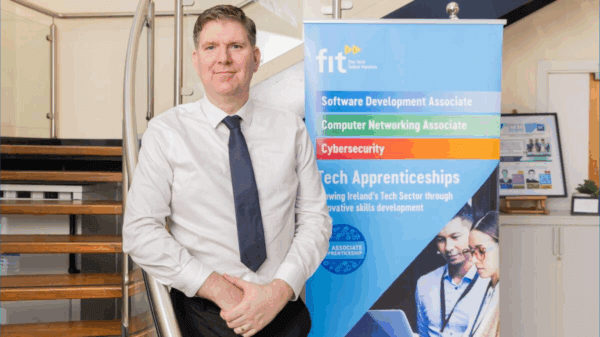
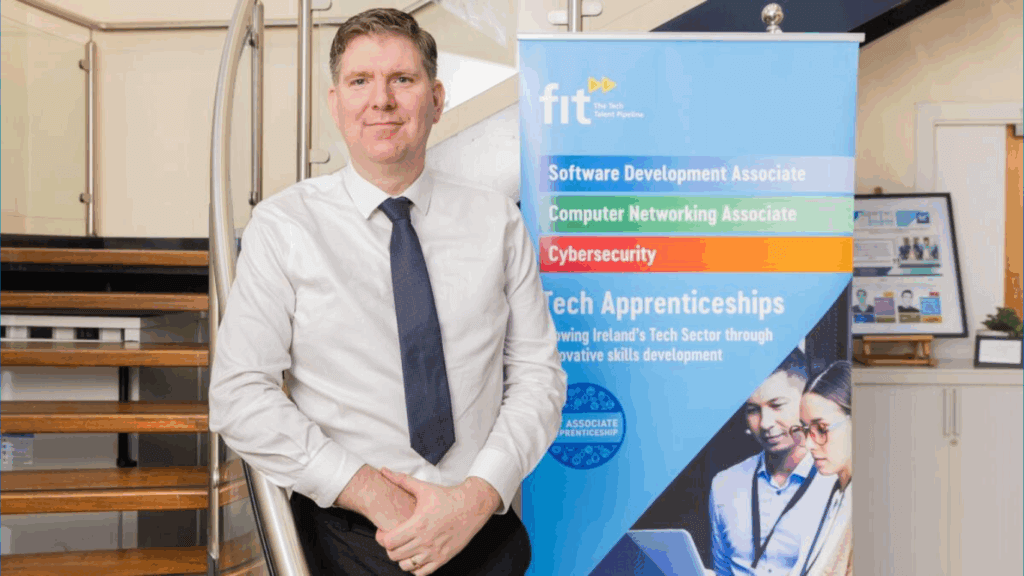
At the heart of that transformation is FIT (Fastrack into Information Technology), a not-for-profit organisation that has been operating since 1999 and working closely with employers to address real-world skills gaps. Today, FIT plays a central role in Ireland’s modern tech apprenticeship ecosystem, helping employers grow talent from the ground up while opening doors for people who may not see traditional third-level education as the right fit.
“FIT is a not-for-profit led by a board of directors with generations of C-suite experience in the technology and related sectors,” said Andrew Finn, director of academic affairs and programme development at FIT. “Close relationships with entities such as IBM, Accenture, SAP, Deloitte, AWS, GCS, and Amundi, among others, position our organisation to promote the tech skills agenda and the potential of the further education sector to address skills deficits in Ireland’s increasingly digitised economy.”
That employer-led focus has allowed FIT to scale rapidly. Each year, more than 5,000 learners access online tech training through FIT partnerships, while a further 3,500 receive employability supports across its initiatives.
But it is the Tech Apprenticeship programmes, first launched in 2018, that best capture the organisation’s impact.
“Since 2018, FIT has continued to expand one of our flagship projects, the Tech Apprenticeship initiative,” Finn explained. “These programmes now represent nearly eight years of operations, with 1,050 apprentices having commenced programmes with 340 employers across Ireland, consisting of a healthy mix of small, medium and large entities from the private and public sectors.”
Our growing scale has made a positive impact on resourcing in the tech sector
The two-year apprenticeships lead to Quality and Qualifications Ireland-accredited advanced certificate awards at NFQ Level 6. Discipline areas currently span software development, computer networking and cybersecurity, with a data analytics programme planned for launch later in 2026. Crucially, they challenge the long-held assumption that graduate-level qualifications are the only route into high-value tech roles.
“The introduction of these programmes has led to a dramatic shift in the tech sector’s reliance on graduate-level qualifications, which has been one of the initiative’s biggest successes,” said Finn. “These programmes continue to grow, and I’m proud, along with my team, of that achievement.”
Remaining relevant in a sector defined by constant change is no mean feat. For FIT, staying ahead means deep engagement with employers and forensic attention to emerging skills needs, rather than chasing headlines.
“It is not so much about looking at trends as about taking a forward-facing approach, examining specific skill requirements within given sectors in forensic-level detail,” said Finn. “A good example of this is the theme of Gen-AI adoption. To ensure we stay ahead of the curve, FIT has looked further into the practical use of these AI-driven technologies at the coalface.”
That emphasis on practical application is what distinguishes apprenticeships from more traditional academic routes. Finn speaks from personal experience when he describes their value.
“Nearly 30 years ago, I undertook a cabinetmaking apprenticeship. This was very low tech and traditional, but I gained useful transferable skills, exposure to disciplined work environments and importantly, learned directly from those more accomplished and skilled.”
For candidates now considering their career options, his advice is straightforward. “If you’re looking for hands-on learning in a technology role, with lots of work experience, a statutory apprenticeship fits that mould better than other options, in my opinion.”
And the future is bright for tech apprentices: at a time when artificial intelligence is reshaping workplaces at speed, FIT sees its tech apprenticeships not as vulnerable to this disruption, but as resilient.
“Paradigm change is sometimes once-in-a-lifetime. We are living through that now, as Gen-AI technologies are reorganising how businesses operate. Our belief is that the functional and broad range of roles our programmes target will be augmented by AI in the future rather than completely replaced.”
Just as important is who gets access to these opportunities. FIT has made inclusion a central pillar of its work, with initiatives such as Women Choose Tech and HERO in Tech.
“In the FIT context, there is no shortage of candidates willing to get involved in the programme,” Finn notes. “Participation by women in tech apprenticeships currently exceeds 25 per cent; in 2018, that statistic was less than 10 per cent. FIT is now targeting 33 per cent by the end of 2027.”
Looking ahead, Finn sees FIT’s role as both economic and social. “We started from a point of zero apprentices in situ and are now at a stage where we feel our growing scale has made a positive impact on resourcing in the tech sector. I’d hope I’ve made some impact in ensuring these programmes persist for the betterment of the country into the future.”
Interested in learning more about the benefits of hiring Tech Apprentices? Download our Employer Brochure today.